

Founder: Turnaround Talk
Most South Africans have been paying close attention to the news in the hope that Government is getting closer to resolving the Energy Crisis.
The first part of this was securing funding to address the gargantuan financial hole that Eskom needs to be filled in order to carry out maintenance on its ailing infrastructure. Minister of Electricity Kgosientsho Ramokgopa achieved this at the BRICS Summit when he acquired funding from China.
The next part of this is to release an Energy Bill, which will outline not only the path ahead for Eskom but the future role of Independent Power Producers and the role that renewables will play in our energy mix.
How far are we from seeing this bill?
Important bill
The News24 article points out that the urgent amendments to the Electricity Regulation Act will not be processed before the end of the year, chairperson of the Portfolio Committee on Mineral Resources and Energy Zet Luzipo said on Wednesday.
The committee held its first session on the bill after it was tabled last week.
The bill is essential for the unbundling of Eskom and the modernisation of the electricity supply industry. It is expected to accelerate the entry of multiple generators into the market, relieving the energy supply gap.
The article adds that, among other things, it will establish a National Transmission Company, which will house an independent Transmission System Operator (TSO). The TSO will provide an open market platform that will allow for competitive electricity trading.
A race against time
The article points out that officials from the Department of Mineral Resources and Energy briefed the committee on the changes proposed in the bill on Wednesday. The committee will now call for public submissions, which must remain open for 30 days. It has mapped out a programme of provincial public hearings from 26 September to 3 December.
Deliberations on the bill can only start when the reports from the various public hearings and oral and written submissions have been adopted. Therefore, it is unlikely that a clause-by-clause discussion will occur before Parliament rises for the Christmas recess.
The article adds that Cabinet approved the bill in March, but it was only tabled last week due to an administrative bungle that has yet to be fully explained. There is now a race against time to pass it as law before the end of the sixth administration.
Evasive action
The News24 article points out that DA MP Kevin Mileham attempted to pin Luzipo to a date to begin the deliberations, but the chair said this was impossible as it was not absolutely clear yet when the call for public submissions would go out, and the 30-day clock would start ticking.
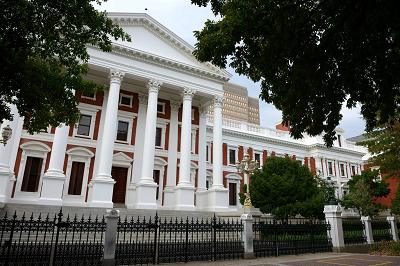
Image By: Getty Images
Committee secretary Ayanda Boss said: “It is going to be difficult to know when we will start (deliberations). It also depends on how many submissions we get. We will only know that after 30 days.”
Neither Minister Gwede Mantashe nor the department’s director-general Jacob Mbele was present at the committee meeting. Both gave apologies due to Cabinet commitments.
The article adds that the Department’s Head of Policy Ntokozo Ngcwabe said that the process to release the long-awaited Integrated Resource Plan (IRP) was under discussion at the Cabinet this week. The department planned to take the completed IRP to the Cabinet for approval in October.
The plot thickens
This is where the plot thickens. Other reports indicate that this bill will not likely be passed this year.
Parliamentary rules point out that any bill that is not passed before a general election needs to be abandoned, and the whole process needs to be started over again under the new Government. This applies even if President Cyril Ramaphosa wins a second term.
This is a serious red flag for companies that are severely hamstrung by loadshedding. If it is currently a root cause of financial distress, there is a good chance it will be in the coming months and possibly years.


