

Founder: Turnaround Talk
Turnaround Talk has published a series of articles that discuss the economic impact of loadshedding. From large retailers (Pick n Pay and Checkers) spending millions on diesel to run generators every month to SMMEs reverting to ancient techniques to keep the wheels of their business turning during loadshedding, the impact of the energy crisis is massive.
We cannot sit back and think that Government is immune from this. Taxpayers are forking out significant amounts of money to try and keep up with the impact that loadshedding has on municipalities. This is these entities’ last lifeline as we enter a critical election year.
The consumer ATM
The News24 article points out that consumers in nearly 80 municipalities had to cough up more than R1.6 billion to repair infrastructure damaged and vandalised in more than 100 incidents per day when the lights go off.
Additionally, at 79 of South Africa’s 257 municipalities, load shedding contributed to revenue losses in excess of R21 billion in total per annum.
The article adds that, responding to a written parliamentary question, Cooperative Governance and Traditional Affairs (Cogta) Minister Thembi Nkadimeng shared details of the South African Local Government Association’s (Salga) assessment of all municipalities in March 2023 to quantify municipal expenditure and revenue losses due to load shedding.
According to Salga’s report, load shedding is so bad that 12% of the surveyed municipalities recorded over 100 incidents per day per load shedding period, of which there could be several per day. The vandalism led to prolonged power cuts as cash-strapped municipalities and Eskom, struggled to bring electricity back online following a load-shedding period.
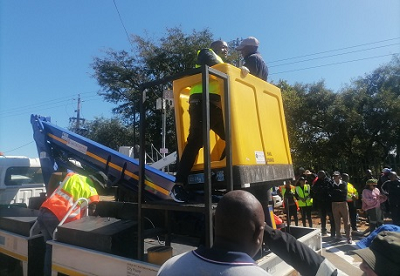
Image By: City Power
Sitting ducks
The article points out that City Power in Johannesburg spends roughly R100 million a year to secure its substations and mini substations against vandalism and theft. In March, City Power complained about the theft of mini-substations, which cost the entity R3 million daily.
In Cape Town, electricity vandalism continues to plague the city, with more than 350 electricity infrastructure incidents recorded in the first three months of this year. At least R40 million was allocated to help fight the vandalism of energy infrastructure.
The article adds that the total cost of fixing and replacing municipal infrastructure and equipment damaged and stolen during load shedding amounted to R1.6 billion for the 2022/23 financial year. The cost to fix damaged Waste-Water Treatment Works and Water Treatment Works and to procure backup generators and diesel was R1.4 billion. The total loss of revenue due to unserved energy (energy not supplied or delivered) from municipalities was more than R21 billion per annum for all municipal licenced distributors.
Municipalities were spending more than R1.1 billion per annum on overtime pay for staff and contractors for repairing electrical infrastructure, in addition to the normal cost budgeted for overtime and service providers.
Are we getting the full picture?
The article points out that According to Salga, all 257 municipalities were contacted to participate in the assessment. However, only 89 municipalities across the country responded. Of these, 75 are Water Service Authorities, and 79 are licenced municipal electricity distributors (these are municipalities that buy bulk electricity from Eskom and resell it to customers, like in the City of Cape Town and Joburg). Independent energy analyst Chris Yelland said the consequences of load shedding were severe.
He said: The whole of South Africa is feeling the impact of load shedding. In other industries, the consequences are worse. Not having supply means customers cannot be provided with electricity. During load shedding, there is increased vandalism and theft of electricity infrastructure. This is a massive cost in itself. Outage as a result of load shedding can cause outages for several days.
“The extra staff time that is needed and the load shedding itself can cause damage to transformers and cables. The costs are absolutely enormous. It has a massive impact on GDP.”
The article adds that Yelland said this was having a negative effect on attracting investment to South Africa and was leading to investors “simply walking away” from local projects, preferring to explore their options in other parts of the world. Yelland said municipalities should pay Eskom to lighten the power utility’s debt burden.
“Municipalities paint themselves as victims. There is massive non-payment by municipalities to Eskom. This means that Eskom does not have money to do the necessary maintenance,” he said.
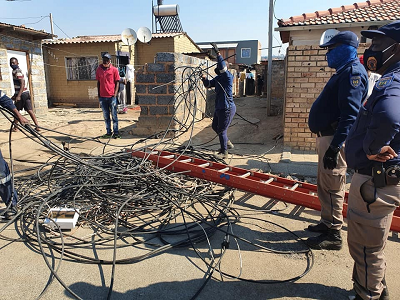
Image By: City Power/Twitter
Signs of financial mismanagement
In August, News24 reported that municipalities are not covering their expenses well. A government white paper states that the revenue generated by municipalities is expected to cover 90% of their expenses. Over a rolling five-year average from 2017 to 2021, municipalities covered 77% of their expenses.
The latest StatsSA report that could be found with the figure was from 2020, when municipalities raised 71% of the value of their expenses.
The article adds that, in May, News24 reported that municipalities owe Eskom R57 billion. Those who want their Eskom debt scrapped will have to collect electricity revenue from consumers and play hardball by cutting them off when they default if they are to benefit from the National Treasury’s municipal debt relief initiative.
Existing challenges
The criminal element is not a new challenge. Part of the problem that Transnet deals with every month is that the company has to fork out significant amounts of cash (that it doesn’t have) to address the impact of vandalism and cable theft on its lines. This challenge is now transcending the entity and becoming a national headache as destitute South Africans turn to criminality to support their families financially.
The rising criminality indicates that the answer to the Energy Crisis needs to include an accelerated move towards establishing South Africa’s green energy sector. Economic growth can be accelerated through renewables, and the job creation opportunities associated with the green economy can address our unemployment crisis. It’s about upskilling and reskilling a workforce to modernise it.
The impact of loadshedding on municipalities needs immediate management. If not, it could significantly impact the business rescue profession in the coming months and have a significant say in the outcome of the 2024 election.