


Partner: GCS
When companies are financially distressed or facing a significant period of disruption, it is important that projects are executed efficiently but also as effectively as possible.
This may prove to be difficult and an area of the business that BRPs and turnaround professionals will need to dedicate a significant amount of time that could be better used elsewhere in the business.
According to a recent Harvard Business Review (HBR) article, leveraging technology may offer a helping hand when it comes to this.
Project Management Today and Path Forward
The HBR article points out that, every year, approximately $48 trillion are invested in projects. Yet according to the Standish Group, only 35% of projects are considered successful. The wasted resources and unrealized benefits of the other 65% are mind-blowing.
For years in HBR research and publications, the company has been promoting the modernisation of project management. One reason we have found why project success rates are so poor is the low level of maturity of technologies available for managing them. Most organisations and project leaders are still using spreadsheets, slides, and other applications that haven’t evolved much over the past few decades. These are adequate when you are measuring project success by deliverables and deadlines met, but they fall short in an environment where projects and initiatives are always adapting — and continuously changing the business. There has been improvement in project portfolio management applications, but planning and team collaboration capabilities, automation and “intelligent” features are still lacking.
If applying AI and other technological innovations to project management could improve the success ratio of projects by just 25%, it would equate to trillions of dollars of value and benefits to organizations, societies, and individuals. Each of the core the technologies described in the story above is ready — the only question now is how soon they will be effectively applied to project management.
The HBR article points out that Gartner’s research indicates that change is coming soon, predicting that by 2030, 80% of project management tasks will be run by AI, powered by big data, machine learning (ML), and natural language processing. A handful of researchers, such as Paul Boudreau in his book Applying Artificial Intelligence Tools to Project Management, and a growing number of startups, have already developed algorithms to apply AI and ML in the world of project management. When this next generation of tools is widely adopted, there will be radical changes.
6 Aspects of Project Management that Will Be Disrupted
HBR sees these coming technological developments as an opportunity like none before.
Organisations and project leaders that are most prepared for this moment of disruption will stand to reap the most rewards. Nearly every aspect of project management, from planning to processes to people, will be affected. Let’s take a look at six key areas.
Better selection and prioritisation
The HBR article points out that selection and prioritisation are a type of prediction: which projects will bring the most value to the organisation? When the correct data is available, ML can detect patterns that can’t be discerned by other means and can vastly exceed human accuracy in making predictions. ML-driven prioritisation will soon result in:
- Faster identification of launch-ready projects that have the right fundamentals in place;
- Selection of projects that have higher chances of success and delivering the highest benefits;
- A better balance in the project portfolio and overview of risk in the organisation; and
- Removal of human biases from decision-making.

Image By: Canva
Support for the project management office
The HBR article points out that data analytics and automation startups are now helping organisations streamline and optimise the project management office (PMO) role. The most famous case is President Emmanuel Macron’s use of the latest technology to maintain up-to-date information about every French public-sector project. These new intelligent tools will radically transform the way PMOs operate and perform with:
- Better monitoring of project progress;
- The capability to anticipate potential problems and to address some simple ones automatically;
- Automated preparation and distribution of project reports and gathering of feedback;
- Greater sophistication in selecting the best project management methodology for each project;
- Compliance monitoring for processes and policies; and
- Automation, via virtual assistants, of support functions such as status updates, risk assessment, and stakeholder analysis.
Improved, faster project definition, planning, and reporting
The article adds that risk management is one of the most developed areas in project management automation. New applications use big data and ML to help leaders and project managers anticipate risks that might otherwise go unnoticed. These tools can already propose mitigating actions, and soon, they will be able to adjust the plans automatically to avoid certain types of risks.
Similar approaches will soon facilitate project definition, planning, and reporting. These exercises are now time-consuming, repetitive, and mostly manual. ML, natural language processing, and plain text output will lead to:
- Improved project scoping by automating the time-consuming collection and analysis of user stories. These tools will reveal potential problems such as ambiguities, duplicates, omissions, inconsistencies, and complexities;
- Tools to facilitate scheduling processes and draft detailed plans and resource demands; and
- Automated reporting that is not only produced with less labour but will replace today’s reports — which are often weeks old — with real-time data. These tools will also drill deeper than is currently possible, displaying project status, benefits achieved, potential slippage, and team sentiment clearly and objectively.
Virtual project assistants
The article points out that, practically overnight, ChatGPT changed the world’s understanding of how AI can analyse massive sets of data and generate novel and immediate insights in plain text. In project management, tools like these will power “bots” or “virtual assistants.” Oracle recently announced a new project management digital assistant, which provides instant status updates and helps users update time and task progress via text, voice or chat.
The digital assistant learns from past time entries, project planning data, and the overall context to tailor interactions and smartly capture critical project information. PMOtto is a ML-enabled virtual project assistant that is already in use. A user can ask PMOtto “Schedule John to paint the wall next week and allocate him full time to the task.” The assistant might reply, “Based on previous similar tasks allocated to John, it seems that he will need two weeks to do the work and not one week as you requested. Should I adjust it?”
Advanced testing systems and software
The HBR article adds that testing is another essential task in most projects, and project managers need to test early and often. It’s rare today to find a major project without multiple systems and types of software that must be tested before the project goes live. Soon, advanced testing systems that are now only feasible for certain megaprojects will become widely available.
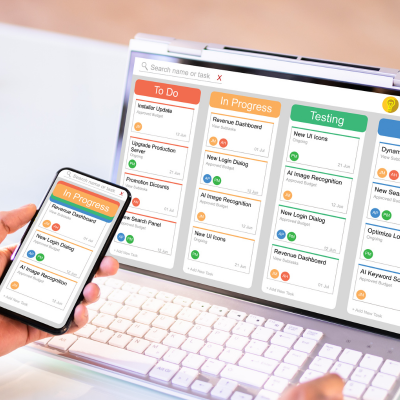
Image By: Canva
The Elizabeth line, part of the Crossrail project in the United Kingdom, is a complex railway with new stations, new infrastructure, new tracks, and new trains; it was, therefore, important that every element of the project went through a rigorous testing and commissioning process to ensure safety and reliability. It required a never-before-seen combination of hardware and software, and after initial challenges, the project team developed the Crossrail Integration Facility. This fully automated off-site testing facility has proven invaluable in increasing systems’ efficiency, cost-effectiveness, and resilience. Systems engineer Alessandra Scholl-Sternberg describes some its features: “An extensive system automation library has been written, which enables complex set-ups to be achieved, health checks to be accurately performed, endurance testing to occur over extended periods and the implementation of tests of repetitive nature.” Rigorous audits can be run at the facility 24-7, free from the risk of operator bias.
Advanced and automated system testing solutions for software projects will soon allow early detection of defects and self-correcting processes. This will significantly reduce time spent on cumbersome testing activities, reduce the number of reworks, and ultimately, deliver easy-to-use and bug-free solutions.
A new role for the project manager
The HBR article points out that, for many project managers, automating a significant part of their current tasks may feel scary, but successful ones will learn to use these tools to their advantage. Project managers will not be going away, but they will need to embrace these changes and take advantage of the new technologies. We currently think of cross-functional project teams as a group of individuals, but we may soon think of them as a group of humans and robots.
With a shift away from administrative work, the future project manager will need to cultivate strong soft skills, leadership capabilities, strategic thinking, and business acumen. They must focus on the delivery of the expected benefits and their alignment with strategic goals. They will also need a good understanding of these technologies. Some organizations are already building AI into their project management education and certification programs, and Northeastern University is incorporating AI into its curriculum, teaching project managers how to use AI to automate and improve data sets and optimize investment value from projects.
Significant investment
We have seen many companies who are reluctant to make significant investments in technology as they are unsure about how it will add value.
However, technology will not disappear, and leveraging the Production Possibility Frontier can benefit a company. The Production Possibility Frontier uses technology to help companies with finite resources work beyond their infrastructure challenges to achieve value.
While technology investment is significant and scary, it can add significant value to a company and should not be overlooked. Don’t let fear paralyse you into inaction.
At a glance
Only 35% of projects today are completed successfully. One reason for this disappointing rate is the low level of maturity of technologies available for project management. This is about to change. Researchers, startups, and innovating organizations are beginning to apply AI, machine learning, and other advanced technologies to project management, and by 2030, the field will undergo major shifts. Technology will soon improve project selection and prioritisation, monitor progress, speed up reporting, and facilitate testing.
Project managers, aided by virtual project assistants, will find their roles more focused on coaching and stakeholder management than on administration and manual tasks. The article shows how organizations that want to reap the benefits of project management technologies should begin today by gathering and cleaning project data, preparing their people, and dedicating the resources necessary to drive this transformation.


