


Now that we have moved on from the GNU negotiations, the hard work begins in earnest.
It is no secret that South Africa desperately needs interventions that will bring about economic reform and a fresh start for businesses. Businesses must capitalise on optimised conditions that will facilitate economic growth rather than financial distress and liquidations.
Will the new cabinet that President Ramaphosa announced be able to achieve this?
Treasury
The News24 article points out that the 67-year-old Enoch Godongwana has been appointed finance minister again—a role he has had for almost three years. He replaced Tito Mboweni in 2021, halfway through President Cyril Ramaphosa’s first term.
He has made his mark as a pragmatic and responsible steward of the country’s finances who will not bow to populism. He wields considerable heft in the ANC, where he was head of the economic transformation committee for over 10 years and has earned the respect of both business and labour.
The article adds that Godongwana’s top priority since becoming finance minister has been to arrest SA’s rising debt and debt service costs that are consuming an ever-larger share of the national budget. To do this, he has held the line on government spending, and will this year achieve a primary budget surplus for the first time in 15 years.
Godongwana has also demonstrated courage and determination in tackling problems his predecessors avoided, such as the Eskom debt and e-tolls.
However, towards the end of the election campaign, the ANC passed the NHI Bill and announced its intention to implement a fivefold increase in welfare grants to the unemployed, both of which are unaffordable.
The article points out that, while Godongwana’s reappointment came as no surprise, the biggest change to the portfolio was the naming of two deputy finance ministers: David Masondo from the ANC, who returns to the role, and the addition of the DA’s Ashor Sarupen.

Image By: Image By: Darren Steward/Gallo Images
The 49-year-old Masondo is often regarded as one of the up-and-coming ministers, having been deputy under both Mboweni and Godongwana. He was the founding chairperson of the Young Communist League and was the former SRC President during his time at Wits University.
The article points out that Masondo was Finance MEC in Limpopo and was the chief executive officer of the Automotive Industry Development Centre under the Gauteng provincial government. He is a member of the ANC’s Economic Transformation Committee and is the founding principal of the OR Tambo School of Leadership. He previously worked as a lecturer at Wits University, teaching states and markets at an undergraduate level and the political economy of modern South Africa at a postgraduate level.
Sarupen has moved up the ranks in the DA since joining the party at 17 in his hometown of Springs on the East Rand. He has BSC Honours and, an MBA from Wits, and an MPhil in Corporate Strategy from the Gordon Institute of Business Science, with research into the impact of anti-globalisation on the South African economy.
The article adds that he was elected to the Ekurhuleni metro’s council in 2011 and was chief whip of the opposition by the age of 22. In 2014 he was made election strategist for Gauteng and then served on the provincial legislature until 2019, when he was appointed DA chief of staff and eventually Helen Zille’s Parliamentary counsel.
In 2020, he made it to the DA’s national leadership as the deputy chair of the Federal Council, and in 2021 was appointed as the DA’s deputy national campaign manager for the local government elections. Since 2019, Sarupen has served as an MP and the DA’s Shadow Minister on the Appropriations Committee – which deals with the national budget.
Trade and Industry
The News24 article points out that the trade, industry and competition ministry will be headed by the ANC’s Parks Tau, who served as mayor of Johannesburg between 2011 and 2016.
Tau takes over from the ANC’s Ebrahim Patel, who announced his retirement after 15 years in Cabinet, including five as minister of trade and industry.
The article adds that the 54-year-old Tau, born in Soweto, was replaced by the DA’s Herman Mashaba as Johannesburg mayor in 2016. Three years later, in 2019, he was named as deputy minister of cooperative governance and traditional affairs (Cogta). But he only served in this role briefly before taking up the post of MEC for economic development in the Gauteng provincial government.
He was reappointed deputy minister at Cogta in March last year. His deputy ministers are the ANC’s Zuko Godlimpi, deputy chair of his party’s economic transformation subcommittee, and the DA’s Andrew Whitfield. Whitfield has served as the DA’s shadow police minister since June 2019. He is also his party’s leader in the Eastern Cape.
The article points out that Tau will have to hit the ground running with several urgent matters demanding his attention. Chief among these is keeping South Africa within the African Growth and Opportunity Act (AGOA), which grants the country duty-free access for thousands of goods to the USA.
Tau will also need to decide whether to tinker with the eleven “master plans” that Patel implemented over the past five years to revitalise SA’s key manufacturing sectors.
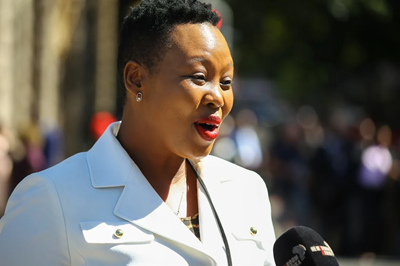
Image By: Ziyaad Douglas/Gallo Images
Small Business Development
The News24 article points out that while the ANC’s Stella Ndabeni-Abrahams will stay on as the Department of Small Business Development (DSBD) minister, she will be joined by a DA deputy minister, Jane Sithole.
The DSBD doesn’t grab many headlines, but it is responsible for developing a crucial part of the South African economy. Employment growth and innovation are dependent on the success of small businesses.
Speaking on a government television program earlier this year, Ndabeni-Abrahams said that the biggest challenges facing small businesses are crime and access to markets.
The article adds that Ndabeni-Abrahams cut her teeth in the Department of Communications and Digital Technology, as it is now known, where she served in various roles from 2011 to 2021, including as minister for the last three years of her tenure.
She voluntarily submitted herself to the ANC Integrity Commission in 2020 after a series of media reports alleged that her then-husband, Thato Abrahams, had business dealings in the communications sector, which was then under her purview. She said that she submitted herself as a commitment to root out corruption in the department.
She became DSBD minister in 2021 and has overseen programs to provide state funding, training, and equipment to entrepreneurs based in rural and township areas.
The article points out that Ndabeni-Abrahams will now be supported by the DA’s Jane Sithole, who was appointed as a member of the National Assembly for the first time this election.
Sithole spent nearly two decades at Eskom working as a human resources manager. She turned to politics in 2014 as a member of the Mpumalanga provincial legislature. She served a stint as the party provincial leader for Mpumalanga during that time and sat on portfolio committees for health, social development, education, and sport.
Key miniseries
Outside of the obvious Ministry of Electricity and Energy, led by Kgosientsho Ramokgopa, other key ministries must be optimised.
Trade and Industry will always have a significant say in economic development, and it will be interesting to see if Tau can bring in ideas that eluded Rob Davis and Ebrahim Patel. Optimise this department, and business rescues/liquidations will decrease.
Small business development is a key focal area. While seemingly innocuous, South Africa can grow its economy through digital entrepreneurship by enabling small and medium businesses to create a platform to access a global client base.
Finally, it is interesting to note Ramaphosa’s strategic move. In the past, Eskom had the attention of three ministers and the President. Moving energy away from Mantashe and not naming a new Minister of Public Enterprises tends to suggest that Eskom will now only have the attention of Ramokgopa and Ramaphosa.
We live in interesting times.


