
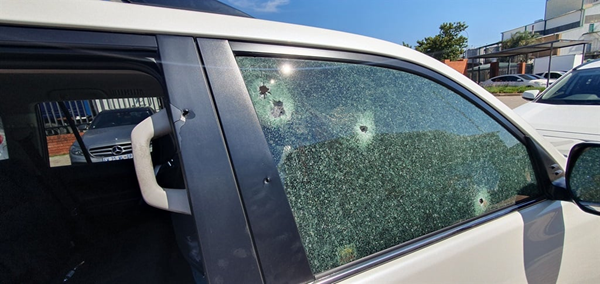
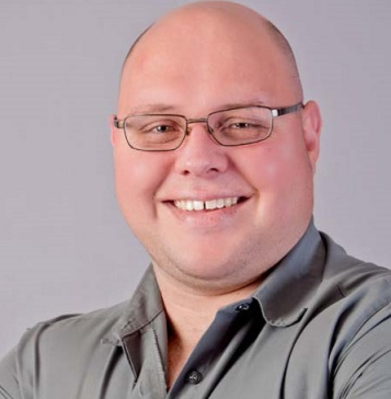
The Cloete and Thomas Murray murders were a massive shock to the business rescue and liquidation profession. Two prominent liquidators were brutally gunned down just for doing their jobs.
Through other media outlets, Turnaround Talk has been following this story for some time. In April, we published an article which pointed out that the police were no closer to finding the triggerman who committed the murders despite strong suspicions surrounding a particular person of interest that the police should be interrogating.
In the next edition of the News24 expose into this story, we will take a closer look at the empire that the Murrays were in the process of dismantling at the time of the murder.
Ghanaian paradise
A News24 investigation spanning more than a year has revealed an expansive web of corruption spun by the Singhs in Ghana, where they secured a handful of road and hospital construction contracts, worth at least R1 billion, and maintained favour by paying at least R50 million in bribes to influential politicians in that country.
The contracts, awarded between 2015 and 2019, were for the rehabilitation and construction of more than 100 kilometres of roads and storm drains, as well as construction work on several hospitals as a subcontractor. Their business, Ghana Infrastructure Company (GIC), was paid the equivalent of R340 million for work completed between September 2017 and November 2022.
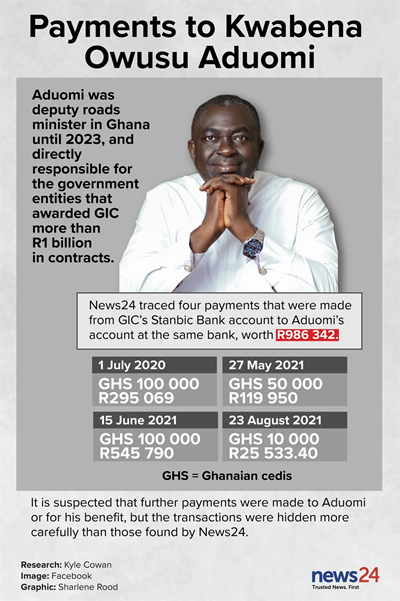
Image By: News24
The article it is impossible to place a definitive value on the projects as it appears the value was inflated in documents submitted to the banks to secure loans – in some cases, the total value was given as more than R3 billion, but News24’s estimation is that the contracts were worth just over R1 billion.
The value of the contracts and payments due for work already completed were used to secure loans worth more than R550 million from Investec between 2016 and 2021, and a R22 million overdraft for the company account from Standard Bank.
Misusing funds?
According to thousands of documents reviewed by News24 and dozens of interviews with a key source, who has intimate knowledge of their business affairs, the Singhs used the loans from Investec meant for construction work in Ghana to fund an extravagant lifestyle, including:
- Spending more than R120 million on cars, including five McLarens, three of which are ultra-rare McLaren supercars, and the actual black Porsche 964 from the first Bad Boys movie, each worth a small fortune;
- At least R60 million was spent on buying, demolishing and constructing a monstrous house on the exclusive Lawley Street in Waterkloof, Pretoria, which has an estimated R100 million price tag at completion;
- Some of the money secured from Investec was used for the Ghanaian business, but it was also either squirreled away in personal bank accounts or used to meet some loan repayments, monthly insurance payments for the luxury cars, and countless millions spent on extensive international travels by the Singhs and a Ghanaian politician;
- At least R340 million was paid by the Ghanaian government to the Singhs’ company for various projects between 2017 and 2022, with an estimated R200 to R400 million more owed for work already completed; and
- Despite the glut of money, some workers in Ghana were paid the equivalent of between R4 000 and R6 000 for a full month’s work.
Key individuals
News24 has confirmed the identity of two key individuals who worked with the Singhs in Ghana – former Deputy Roads Minister Kwabena Owusu Aduomi, who was until 2023 part of the current ruling party in Ghana, the New Patriotic Party. Aduomi recently ran for a parliamentary seat in his Ejisu constituency, under the banner of a different party, a seat he previously lost in 2020, but lost his bid narrowly.
While it is suspected that more money flowed to Aduomi, records seen by News24 confirm 390 000 Ghanaian cedis (about R986 000) was paid directly to his bank account from the Singhs’ company in that country, GIC.
The article points out that the Singhs’ closest associate was former Minister and former National Democratic Party Parliamentary Leader and MP, Haruna Iddrisu. Here, GIC’s relationship stretches back to at least 2015, when money started flowing to causes linked to Haruna – at least GHS20 million, the equivalent of more than R47 million. Haruna, in exchange, brokered contracts for GIC worth more than GHS400 million – worth close to R1 billion.
Aduomi is not a signatory to the contracts but in his capacity as deputy roads minister, he was in charge of the departments responsible for the administration of the bids – most of the deals were awarded on a sole source basis.
But it appears that Haruna was their main go-to person to secure contracts in the Ashanti region, from where Aduomi hails, and in Tamale, Haruna’s constituency.
The article adds that Haruna also played a vital role in securing GIC a subcontract for the construction of an 80-bed hospital in Buipe, part of a major procurement by the Ghanaian health ministry for the construction of four regional hospitals and a clinic, which was awarded to German company Vamed’s Middle Eastern subsidiary.
Again, it is unclear what these contracts were worth in reality – as the values were often inflated in documents submitted to public entities in Ghana or the banks.
While it is unclear what Haruna’s involvement in securing the hospital work for GIC entailed, he was paid at least R10 million in “profit share” from the project, in addition to facilitation fees and it appears the construction of his house which GIC paid for.
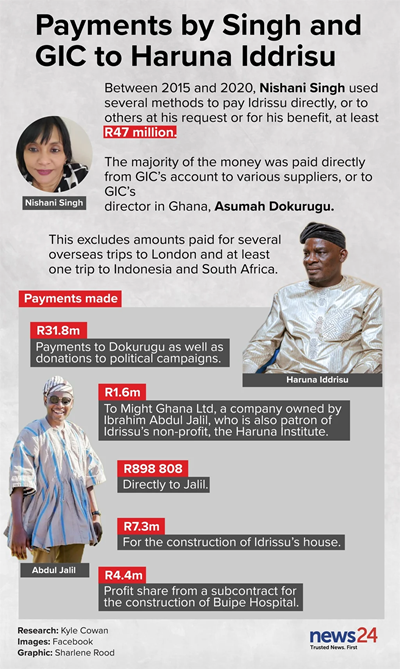
Image By: News24
He refused to acknowledge or respond to multiple requests for comment sent to his private email address and to persons who have previously spoken for his non-profit organisation. Haruna also ignored posts on his active social media pages asking him to reach out to News24.
Aduomi, similarly, did not respond. News24 also reached out to the Ghana High Commission in South Africa, with no response forthcoming.
The Singhs, through GIC, also paid millions of rands in further payments to their local representative, Asumah Dokurugu, money that was earmarked for Haruna and other as yet unidentified officials.
In total, GIC and the Singhs paid more than R94 million in “facilitation fees” or “project fees” that appear to have been poorly disguised bribes, nearly half of which went to Haruna.
The falling empire
The article points out that the full scope of their activities, including treating the company accounts as personal slush funds, tax implications of moving money around in such a fashion, and the possible unlawful enrichment of politicians, would take extensive forensic investigation to untangle – a job that had been started by Cloete Murray when he was appointed by the Master of the High Court to liquidate the Singhs’ main South African company, BIG Business Innovations Group.
The near constant flow of money between BIG and the Ghanaian entity, GIC, meant Murray would inevitably have sought to recover not only the supercars stashed all over the world but also the millions in cash hidden in bank accounts, chiefly in Ghana.
The article adds that Investec was also seeking to take control of GIC and recover the remainder of the R250 million loan granted to that company in 2019.
Something is rotten in the state
Something is rotten in the state of Denmark is one of the most prophetic and most quoted lines from the Shakespeare play Hamlet.
The Murray murders have the same stench as the Brent Kebble murder, as well as the Gavin Watson suicide. Something does not quite add up, and all roads lead to higher offices where the accusations of political involvement just will not disappear. As we move to the voting polls this week, will we be voting in a Government that will enact change and bring justice for the Murrays?
Many political parties have said that a perfect way to create jobs is to increase the number of police officers. That may be a noble gesture, but it is not about how busy you are; it is what you are busy with. Like most things in South Africa, skills are desperately needed instead of numbers. The mosquito is swatted, and the bee is praised.
We live in interesting times.